The roof is arguably the most critical element of any building. When it fails, water gets in — and water getting in causes damage that ripples out to virtually every other part of the structure. Yet it's also one of the elements that buyers think about least, precisely because it's the hardest to see without specialist knowledge. As a RICS regulated surveyor based in Cannock, the roof is always one of the first things I focus on during any property inspection — and the findings often shape the rest of the report.
In this guide, I'll walk you through exactly what we look at during a roof inspection, explain the most common defects we find in Staffordshire properties, and help you understand when a problem is a minor maintenance issue versus a major structural concern requiring urgent attention.
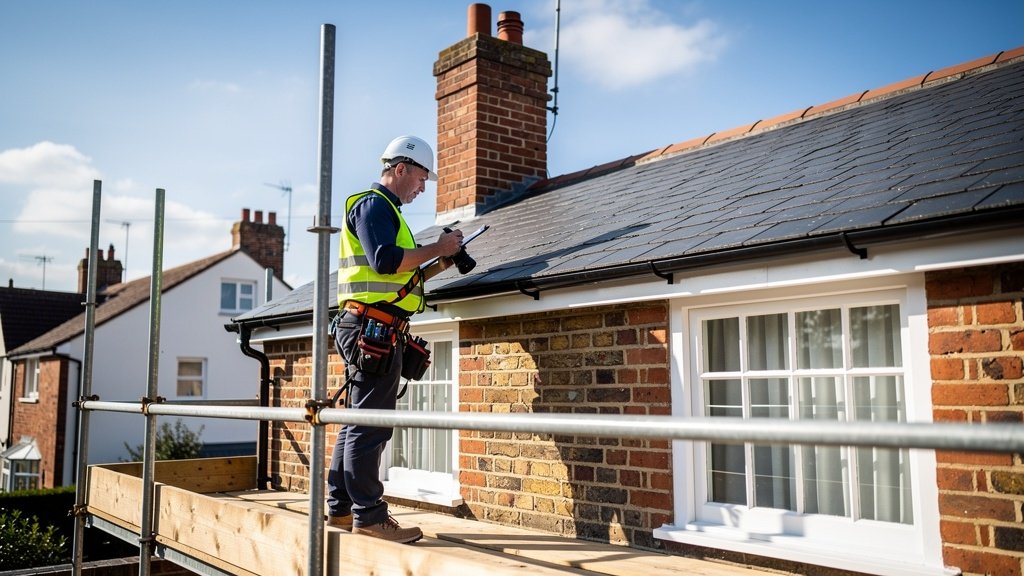
Why the Roof Is So Important in a Property Survey
In a typical RICS Level 2 or Level 3 survey, the roof covers multiple inspection elements: the external covering (tiles, slates, or flat roof finish), the chimney stacks, the guttering and rainwater goods, the roof structure (visible from the loft), and the underside of any flat roof sections. Each of these can fail independently — and all of them affect the building's weathertightness.
What I've learned over 12 years of surveying is that the roof's condition at the time of inspection often tells you a great deal about how well the property has been maintained overall. An owner who has let a roof deteriorate has often let other things slide too. Conversely, a well-maintained roof — with recent repointing, cleared gutters, and intact flashing — usually signals a property that's been cared for properly.
How Surveyors Inspect a Roof
During a building survey, I inspect the roof using several methods depending on access and visibility:
- External visual inspection: Binoculars are used to examine roof slopes, ridge tiles, hips, verges, chimneys, flashing and the condition of the covering material from the ground or from an accessible window or dormer. I always walk the full perimeter of the property to check all elevations.
- Ladder access: Where safely achievable, I'll use a ladder to access flat roof sections, valley gutters, or to get a closer view of a chimney or flashings that can't be properly assessed from the ground.
- Internal loft inspection: I access the loft (where there is safe access) to inspect the roof structure from below — rafters, purlins, binders, struts, and the sarking felt (underlay). This internal view often reveals defects not visible externally, such as rafter spread, sagging felt, daylight through gaps, or evidence of historical water ingress.
- Moisture meter checks: Where I notice staining or suspect moisture penetration at ceiling level, I'll use a moisture meter to test the ceiling and internal wall surfaces below the roof.
It's worth noting that surveyors are not required to lift roof coverings, cut into finishes, or use specialist equipment like thermal cameras as part of a standard survey — though these can be commissioned as additional investigations where warranted. Our services also include thermal imaging surveys for clients who want a deeper investigation of moisture or insulation issues.
The Most Common Roof Defects in Cannock Properties
Having surveyed hundreds of homes across Cannock, Hednesford, Rugeley and Burntwood, I've seen certain roof defects crop up time and again. Here's a breakdown of the most common issues, their severity, and typical repair costs:
| Defect | Severity | Typical Repair Cost | Notes |
|---|---|---|---|
| Missing or slipped roof tiles | Medium | £150–£500 | Immediate action needed to prevent water ingress |
| Failed pointing to ridge/hip tiles | Medium | £400–£1,200 | Mortar bedding deteriorates with age; dry-fix systems now preferred |
| Cracked or deteriorated chimney stack | High | £600–£3,000+ | Can cause serious water penetration into roof voids and internal walls |
| Failed lead or zinc flashing | High | £300–£800 | Flashing seals the joint between roof and vertical surfaces; failure leads to water penetration |
| Blocked or leaking gutters | Low–Medium | £100–£400 | Overflowing gutters cause damp penetration to external walls over time |
| Worn or deteriorated flat roof felt | High | £800–£3,500 | Most felt flat roofs have a lifespan of 15–20 years; replacement with GRP or EPDM is recommended |
| Rafter spread or structural movement | High | £2,000–£8,000+ | Requires a structural engineer assessment; may be linked to collar tie removal or inadequate bracing |
| Deteriorated sarking felt (underlay) | Medium | Included in full re-roofing cost | Most properties built before 1975 lack a modern breathable underlay; often not replaced until a full re-roof |
| Lead valley gutter failure | High | £400–£1,200 | Valley gutters collect significant volumes of water; failure leads to widespread ceiling damage |
| Vegetation growth on roof | Low | £200–£600 | Moss and lichen retain moisture and can lift tiles over time; biocide treatment and clearing recommended |
Understanding Flat Roofs: A Common Problem Area
Many properties in Cannock — particularly those built in the 1960s and 1970s — have flat roofs over rear extensions, garages, or bay windows. Flat roofs are inherently more prone to water ingress than pitched roofs, and the traditional bitumen felt finish has a relatively short lifespan of 10–20 years.
When I inspect a flat roof, I'm looking for:
- Ponding water — standing water indicates falls are inadequate or blocked outlets. This accelerates felt deterioration.
- Blistering or cracking of the felt surface — UV degradation causes felt to become brittle and crack, breaking the waterproof seal.
- Splits at upstands and perimeters — the edges of a flat roof are the most vulnerable points; thermal movement can cause splits to develop over time.
- Condition of the decking below — if water has already penetrated and saturated the timber decking, it may be soft and require replacement as part of a re-roofing project.
If your survey report identifies a flat roof in poor condition, I'd strongly recommend obtaining quotes for replacement rather than repair. Patching a failing felt roof rarely provides a lasting solution — the underlying deterioration continues, and you'll be back to the same problem within a few years. Modern alternatives like GRP (fibreglass) or EPDM (rubber) flat roofing offer a 25–50 year lifespan and are well worth the additional investment.
On one memorable survey in Rugeley, the surveyor's ladder inspection of a flat garage roof revealed not just failing felt but several square metres of soft, punky decking below — evidence that water had been getting in for years. The buyers were expecting to pay around £600 for a patch repair; the actual cost was closer to £3,200 for full decking and covering replacement. This is exactly the kind of information that a proper survey is designed to uncover before you exchange contracts.
Chimney Stacks: Often Neglected, Often Expensive
Chimney stacks are exposed to the most severe weather conditions of any part of the building — they project above the roofline and are subject to freeze-thaw cycles, wind, rain, and frost throughout the winter months. In Cannock's older properties, many chimneys haven't been touched since they were last used for an open fire — sometimes decades ago.
Key chimney defects I look for include:
- Spalled or eroded brickwork — frost action causes brick faces to break away, leaving the soft inner brick exposed to further erosion.
- Failed pointing — the mortar joints around chimney brickwork are particularly vulnerable; once they open up, water enters the stack directly.
- Failed flaunching — the cement fillet around the base of chimney pots. When this cracks, water runs down inside the chimney breast.
- Cracked or missing pots — open pots on unused flues allow rainwater to enter the flue and soak into the chimney breast, causing damp patches on internal walls and ceilings.
- Failed lead flashings at abutment — where the chimney meets the roof slope, lead stepped flashing seals the junction. Failed flashing is a major cause of water ingress.
If you're buying a property with multiple chimney stacks, factor potential chimney repairs into your budget from the outset. Minor repairs — repointing, new flaunching, replacing pots — might cost £300–£600 per stack. More serious structural repairs can run to several thousand pounds, and in extreme cases, a condemned chimney may need to be reduced in height.
What Happens Inside the Roof: The Loft Inspection
The internal loft inspection is one of the most informative parts of any roof assessment. From inside the loft space, I can see the entire roof structure — every rafter, purlin, ridge board, and collar tie — as well as the underside of the roof covering and the condition of the sarking felt.
The key things I'm checking in the loft include:
- Evidence of past or current water ingress — staining on rafters, timbers, or felt is a tell-tale sign of historical leaks. Tide marks show where water has run and dried; dark staining may indicate mould growth.
- Structural integrity of the roof timbers — I look for rafter spread (where the feet of the rafters have pushed out the walls), notched or cut purlins, inadequate bracing, and signs of woodworm or rot.
- Condition of the sarking felt — modern breathable membranes should be intact; older bitumen felt often becomes brittle and torn with age, meaning that water which gets under a displaced tile runs directly onto the ceiling below.
- Adequacy of ventilation — roof voids need to be ventilated to prevent condensation. Blocked eaves ventilation is a common cause of condensation moisture and mould growth on roof timbers.
- Daylight through the covering — any daylight visible through the roof tiles from inside the loft indicates gaps that need immediate attention.
I always advise buyers to ask the vendor directly when the roof was last inspected professionally, and whether any work has been carried out. Many vendors genuinely don't know — roofs are easy to ignore until they fail dramatically. A pre-sale roof inspection is something I recommend to any vendor who wants to avoid surprises during the buyer's survey process.
New Roofs: What to Expect and What to Ask
If the property you're buying has had a recent re-roofing, that's generally positive news. But there are still questions to ask:
- Was the work carried out by a registered contractor? Ask for the company name and check their registration with the NFRC (National Federation of Roofing Contractors).
- Is there a guarantee? Most reputable roofers offer a 10–20 year workmanship guarantee. Ask for the paperwork.
- Was it covered by building regulations? In some cases, a full re-roofing requires building regulations approval. Check whether a completion certificate was obtained.
- Was the underlay replaced? It's surprising how often roofers replace tiles but leave the old underlay in place. If it wasn't replaced, it may be the next item to fail.
During a survey, if I see evidence of recent re-roofing but can't verify the quality of the work, I'll flag it as requiring further investigation — the guarantee and specification documents should be obtained from the vendor before exchange.
When to Get a Specialist Roofer Involved
A building surveyor's inspection is visual and non-destructive. Where I identify roof issues, my survey report will recommend further investigation by a specialist roofing contractor where the defect cannot be fully assessed from a visual inspection alone.
You should involve a specialist roofer when:
- The survey report identifies suspected structural movement in the roof
- There is evidence of widespread water ingress without a clear single cause
- The flat roof is over 15 years old and showing signs of deterioration
- The chimney stack has significant structural damage
- You're considering converting a loft and want to understand the existing structural loading
Always get at least three quotes from reputable, registered contractors. Roofing costs vary significantly, and a detailed written specification will help you compare quotes like-for-like.
Frequently Asked Questions About Roof Inspections
Does a property survey always include a roof inspection?
Yes. All RICS Level 2 and Level 3 surveys include an inspection of accessible roof elements, both externally and from the loft space where access is available. The extent of the inspection is limited to visual, non-destructive methods.
Can a surveyor access the roof surface?
Surveyors carry out a visual inspection using binoculars and may use ladders to access flat roof sections where it's safe to do so. They do not walk on pitched roofs or remove tiles as part of a standard survey.
How much does a roof replacement cost in Cannock?
A full re-roof of a typical semi-detached property in Cannock typically costs £5,000–£12,000 depending on size, roof complexity, tile specification, and whether the underlay and battens are being replaced. Always get a detailed written specification before comparing quotes.
Should I be worried if the survey mentions the roof needs work?
Not necessarily. Minor roof maintenance is normal in any older property. The key is to understand the nature and scale of the work required, get contractor quotes, and either renegotiate the price or budget for the repairs. Your surveyor can advise on priority and urgency.
How often should a roof be inspected?
For most properties, a visual inspection every 2–3 years is sensible — especially after severe weather events. Gutters should be cleared at least annually. A professional inspection every 5–10 years, or before any sale, is good practice.
Book a Building Survey in Cannock Today
Concerned about the roof of a property you're buying? Our Cannock Surveyors team provides thorough, detailed RICS Level 2 and Level 3 surveys that give you a clear, actionable picture of the roof's condition — and every other element of the property. We cover Cannock, Hednesford, Rugeley, Burntwood, Lichfield and the wider Staffordshire area.
Don't leave one of the most expensive potential repair bills to chance. A professional survey is the best investment you can make before buying any property.
Get a Roof Survey or Full Building Survey
Comprehensive RICS-accredited surveys covering all aspects of your property. Fast turnaround, clear reports.
Request a Free Quote